Composite bonding is a significant topic addressed in this article. Composite bonding is one of the essential methods for dental restoration, aiding not only in the reconstruction of damaged teeth but also in enhancing their appearance and functionality. In this article, we will answer questions such as, “How does composite bonding help increase the longevity of dental restorations?”, “What is the difference between FRC composites and traditional materials?”, and other key inquiries. Therefore, if you seek to expand your knowledge in this area, be sure to read this article thoroughly.
How Does Composite Bonding Help Increase the Longevity of Dental Restorations?
Composite bonding significantly increases the longevity of dental restorations due to the use of advanced resins and reinforced filler particles. One of the primary reasons for this improvement is the enhancement of the chemical and mechanical structure of the bonding materials, allowing restorations to withstand higher levels of pressure and impact. Additionally, new composite materials mimic the natural behavior of teeth, providing better performance in everyday conditions.
Recent studies indicate that the use of fiber-reinforced composites (FRC) results in greater coherence in dental restorations due to the creation of a strong adhesive interface. These composites utilize semi-interpenetrating networks (semi-IPN), which improve adhesion to the tooth and enhance the strength of the restoration. As a result, the longevity of restorations is significantly increased with composite bonding.
What Is the Difference Between FRC Composites and Traditional Materials?
One of the crucial advancements in dental restorations is the introduction of fiber-reinforced composites or FRC. These composites use reinforcing fibers that improve the strength and coherence of the restoration. In contrast, traditional composite materials, which consist of simple resins, lack these fibers, making them weaker and less resistant to the pressure and bending experienced by natural teeth.
Research has shown that FRC can create a stronger bond with the tooth structure using semi-IPN networks, which is a significant advantage in dental restorations. This advanced technology helps ensure that the natural and restored tooth structures work in harmony, marking a fundamental difference between traditional materials and FRC.
How Do Coupling Agents Affect Bond Strength in Composite Restorations?
Coupling agents, or primers, play a crucial role in the bond strength of dental composites. These materials establish a strong chemical bond by adhering to both the tooth surface and the composite material, thereby increasing the restoration’s resistance to separation or fracture.
In recent years, spherosilicate primers have emerged as a significant innovation in this field. A study conducted in 2022 demonstrated that the use of these primers enhances bond strength and improves the structural integrity of restored teeth. These advancements have enabled dentists to achieve better long-term outcomes from composite restorations.
How Long Does Composite Bonding Last, and Does It Need to Be Replaced After a Few Years?
The longevity of composite bonding depends on various factors, including the type of materials used and post-restoration care. Generally, composite bonding can last between 5 to 10 years. However, in some cases, it may require repair or replacement, particularly if oral hygiene is neglected or if there are unusual stresses on the tooth.
Modern composite bonding materials, due to their flexibility and high strength, can last for an extended period. Therefore, replacing these restorations after a few years is not typically necessary; however, it is advisable to visit the dentist periodically to assess the condition of the restoration.
Does Composite Bonding Hurt, and Is Anesthesia Required?
Typically, the process of composite bonding involves minimal pain, and in most cases, anesthesia is not required. This method causes less damage to the tooth and is often performed without drilling, resulting in little discomfort.
However, in instances where the dentist must prepare and drill the tooth’s surface, local anesthesia may be employed to ensure the patient does not experience any pain.
How Similar Is Composite Bonding to Natural Teeth, and Is It Noticeable?
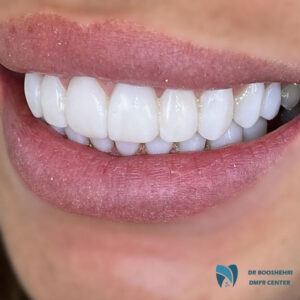
One of the greatest advantages of composite bonding is its excellent compatibility with natural teeth. The dentist can adjust the color and shape of the composite to match your natural teeth seamlessly.
As a result, in most cases, composite bonding is indistinguishable and is designed to resemble your natural teeth. This feature allows individuals to smile confidently and be satisfied with the results of their restoration.
Necessary Care After Composite Bonding
Post-bonding care includes maintaining oral hygiene, avoiding hard foods, and regularly using a toothbrush and dental floss. It is advisable to avoid consuming colored foods and beverages to prevent discoloration of the composite. Furthermore, regular dental check-ups are crucial for monitoring.
Conclusion and Recommendation
This article discussed the advantages and challenges of composite bonding. If you intend to undergo composite bonding, we recommend utilizing the professional services and advice of Dr. Boshiri to achieve the best results. Additionally, online appointment scheduling is available, allowing you to benefit from precise consultations regarding the advantages of composite bonding.